Billing, payment and the till
The bill builds itself from the visit — the consultation, what was dispensed, what was done — and the counter checks it rather than typing it.
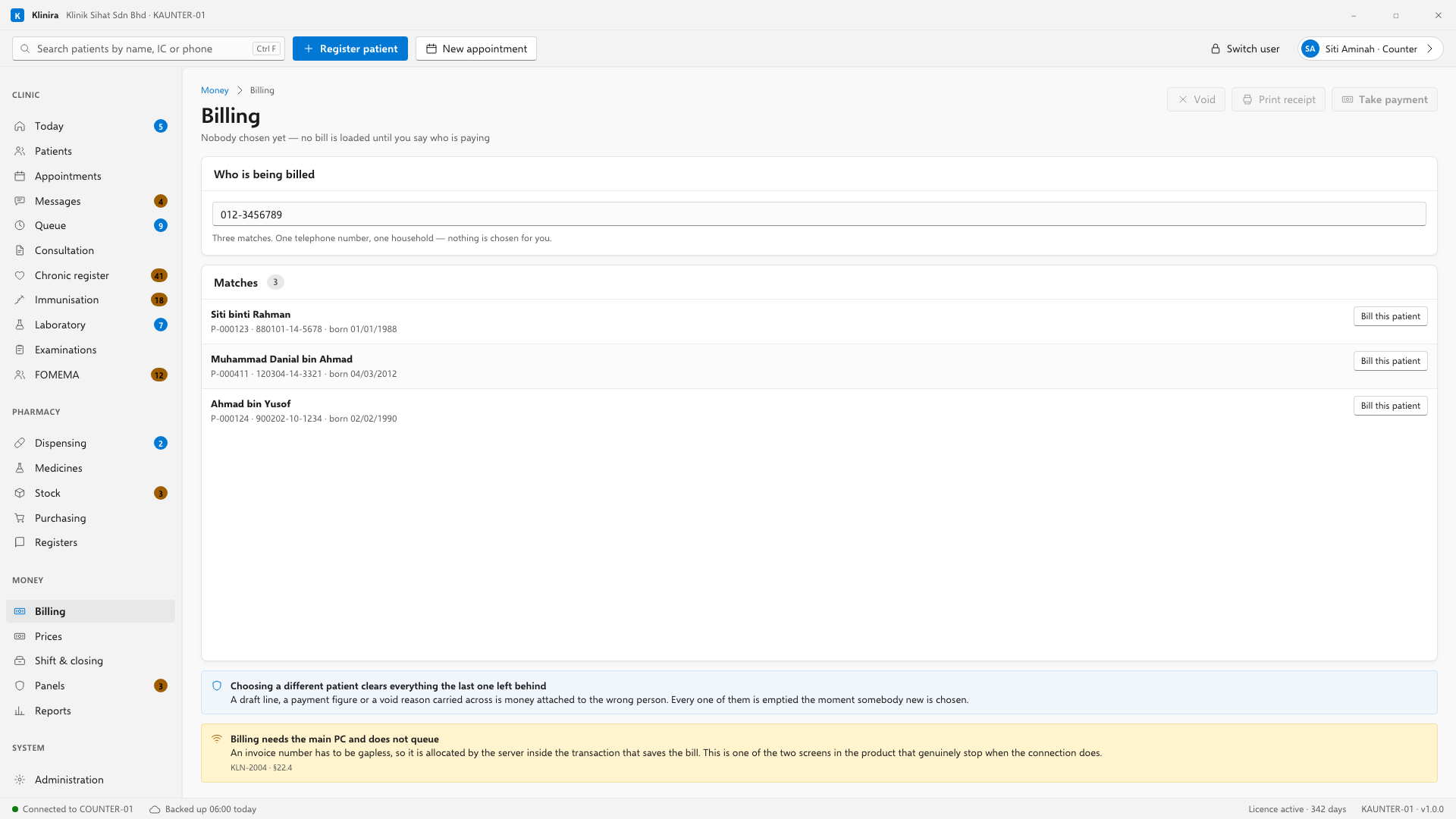
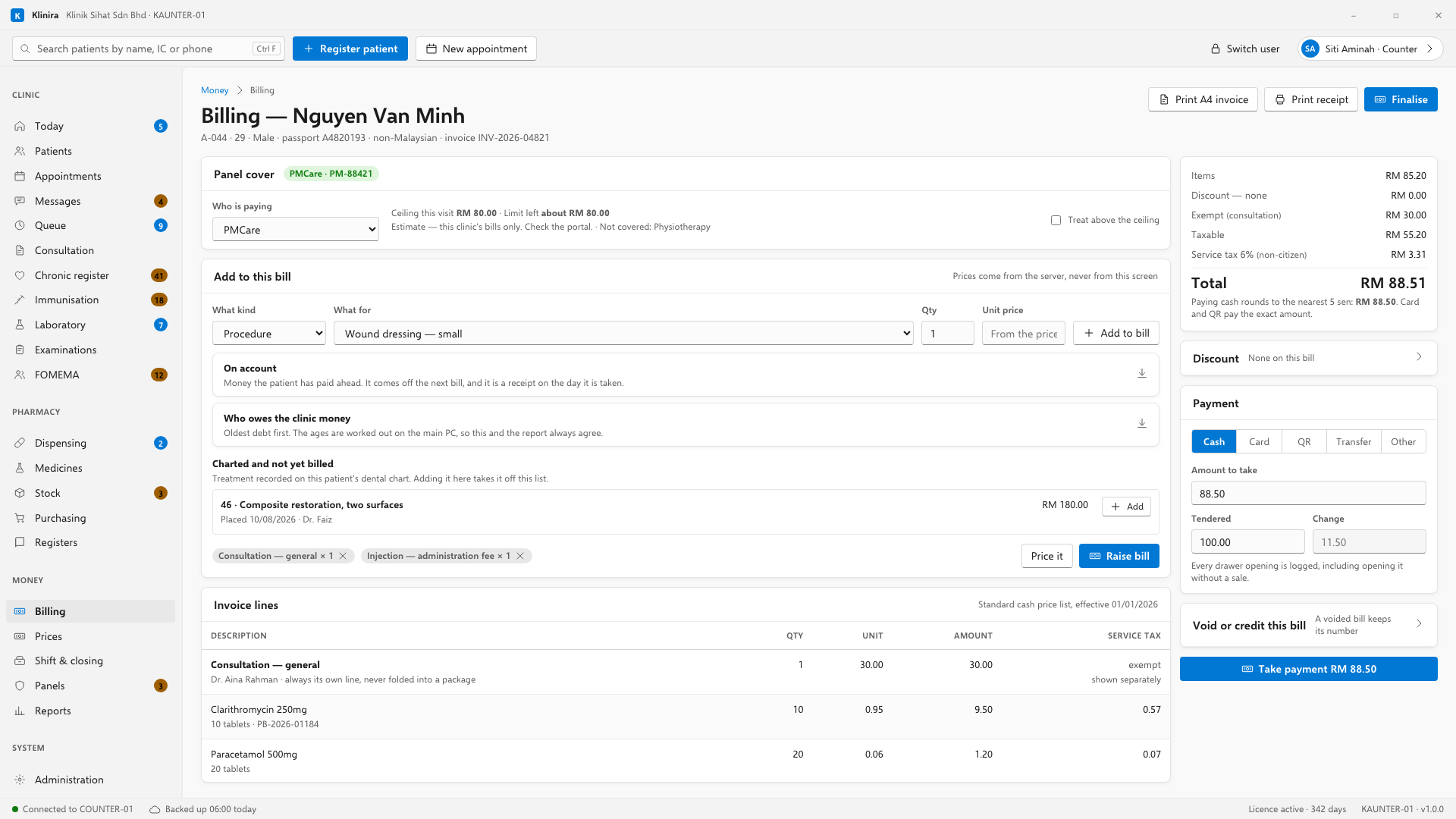
Raising a bill
- 1Choose the patient. The visit's lines are already there.
- 2Add anything that is not automatic — a procedure, a consumable, a certificate.
- 3Apply a discount if the clinic gives one. It reaches the lines before tax is worked out.
- 4Save the draft, or finalise it. Finalising allocates the invoice number.
Two totals, and why
Every bill carries the exact total and, beside it, the figure rounded to the nearest five sen. Bank Negara's rounding applies to an amount settled in cash and to nothing else. A card or QR payment settles the exact figure. So the adjustment is taken when somebody actually pays, because at the moment you finalise the bill nobody knows yet how they will.
Taking payment
- 1Choose how they are paying: cash, card, QR, or against a panel.
- 2For cash, enter what the patient handed over. Klinira shows the change.
- 3Print the receipt, or send it by WhatsApp.
- Part payments are fine. The balance stays on the patient's account.
- A deposit taken earlier can be applied. It shows on the bill as a memo line, because the money was receipted on the day the deposit was taken and counting it twice would report takings the clinic never had.
- A refund is recorded against the original bill, and it subtracts from the day's takings rather than adding to them.
Voiding
A finalised bill is a document the patient has, and once e-Invoice is switched on, so has LHDN. It is never edited. Voiding one writes a void with a reason and leaves the original in place, and it needs a password.
Money paid ahead
On account is the strip inside Add to this bill. A patient paying towards a course of treatment, or leaving a deposit for a procedure, is taking a receipt today for money that will be spent on a bill later — so it is receipted on the day it is taken, and it appears on the later bill as a memo line rather than as takings counted twice.
- The strip shows what the patient has on account before you take any more.
- A deposit is taken by whatever method they paid with, exactly like a bill, and it shows on the shift.
- A blank balance and a zero balance are different things. Blank means it could not be read from the main PC, and Klinira says so rather than drawing a nought.
Who owes the clinic money
The second strip is the debt list, oldest first, with what is over ninety days marked. It is the same figure the ageing report gives an owner — but it is here, at the counter, where somebody who owes money is actually standing.
A patient paying over time
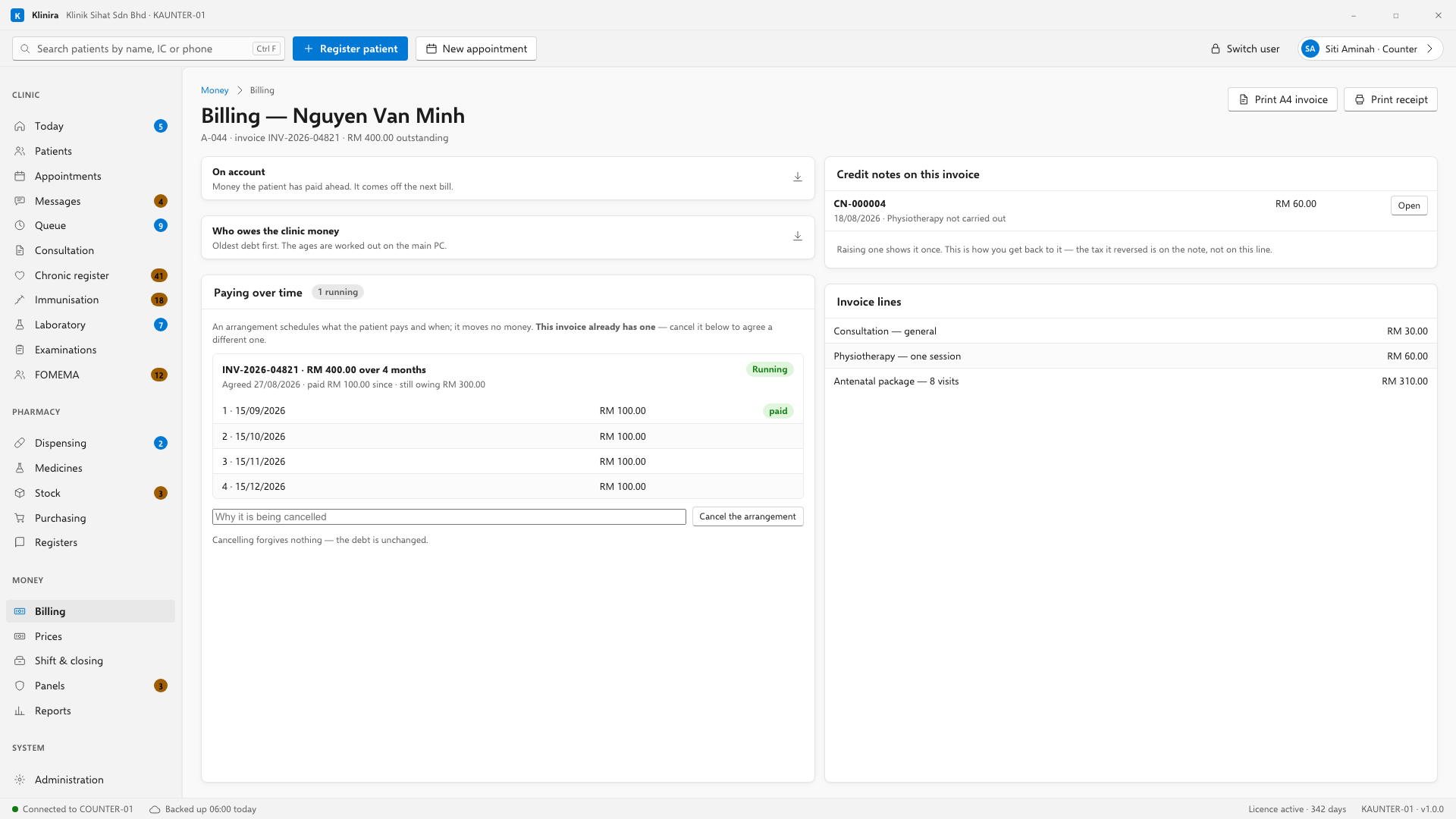
Somebody who cannot settle a bill today can agree to pay it off. Say how many instalments and when the first one falls due — they run monthly from there — and Klinira writes the schedule. It is one arrangement per invoice.
- An arrangement moves no money. Payments are taken against the bill in the ordinary way, and the schedule is read against what was actually paid — so a patient who pays early, pays twice, or pays a different amount is not fighting it.
- A bill may have one arrangement running. To change the terms, cancel the one you have and agree a new one — Klinira does not offer the form while one is running.
- Cancelling forgives nothing. The debt is unchanged and the arrangement stays on the record as a fact about what was once agreed, with the reason you gave.
Credit notes on an invoice
Every credit note raised against the invoice is listed on it. Open one and you get the note as it was issued, with the service tax it reversed — which is the figure your accountant asks for and is not on the line.
Dental treatment that has been charted
A dental clinic sees a third block: treatment recorded on this patient's chart that has not reached a bill yet. Press Add and it becomes a line — and adding it is also what takes it off the list, so the same crown is not offered again next week.
Panel patients
- The panel's rules apply as the bill is built, so the counter sees the split before taking payment rather than discovering it when a claim is rejected.
- Remaining limit, per-visit ceiling and excluded items are shown at the counter.
- Klinira does not submit claims to the TPA. No TPA in Malaysia opens an API to third-party software. Your staff still enter the claim in the TPA portal; what Klinira covers is knowing what has not been paid.
The till session
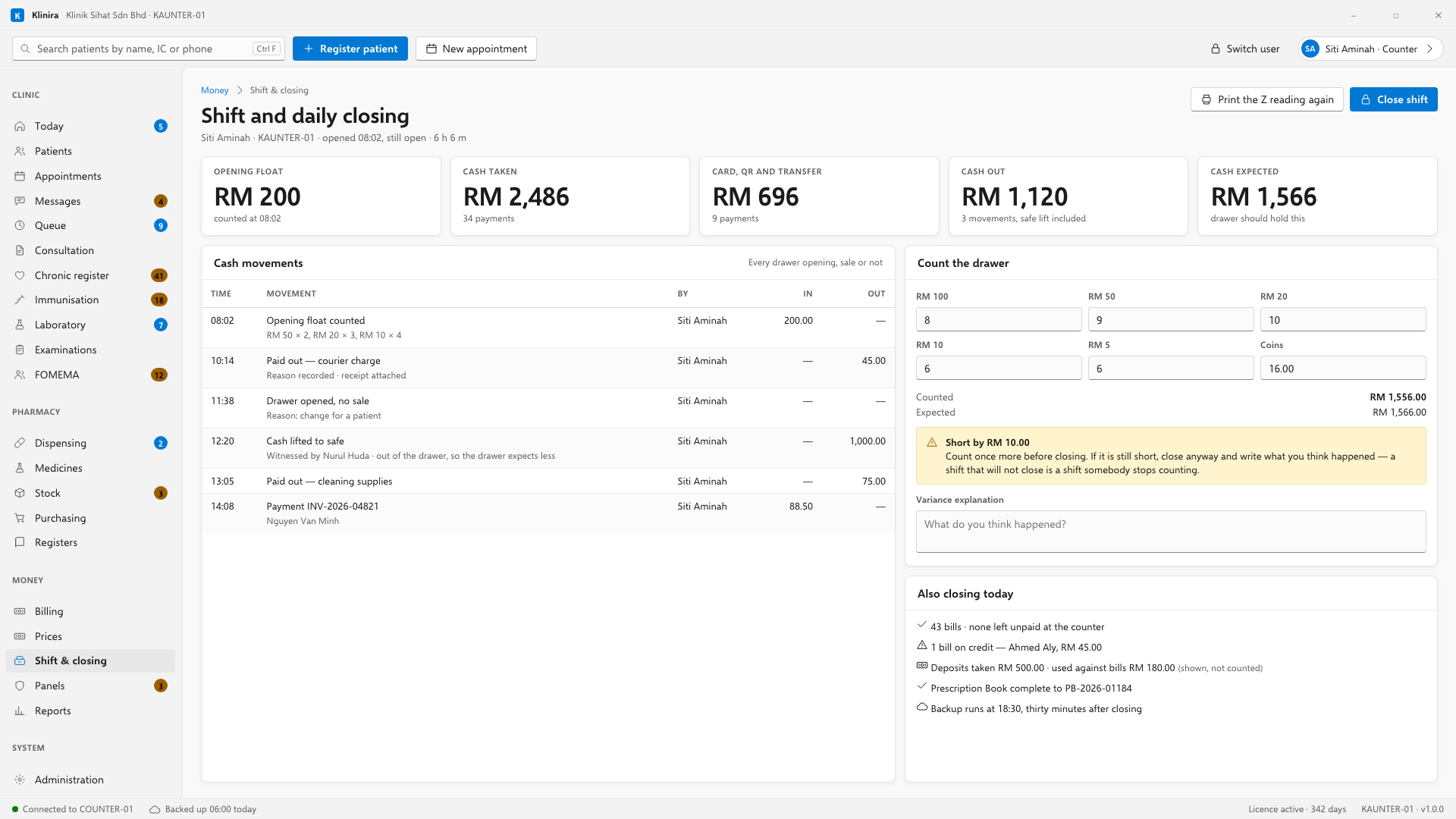
- 1Open the shift at the start of the day with the opening float.
- 2Record any cash taken out or put in during the day, with a reason.
- 3At the end, count the drawer and enter what is there.
- 4Klinira shows the variance. Print the closing report.
If the closing report jams in the printer or goes missing, Print the Z reading again reprints it, marked as a reprint. A till session with no paper behind it is the one thing an owner reconciling a day's takings cannot work around.
Take a place in the first installs
Klinira is being built now. Leave your details and you will hear what is finished, be asked what your clinic actually needs, and get the first install dates when it is ready.