Your first week
The installation finishes on one afternoon. The clinic finishes some days later, when the paper day-book goes into a drawer and does not come out again. Ten things sit between the two, and the system keeps the list for you.
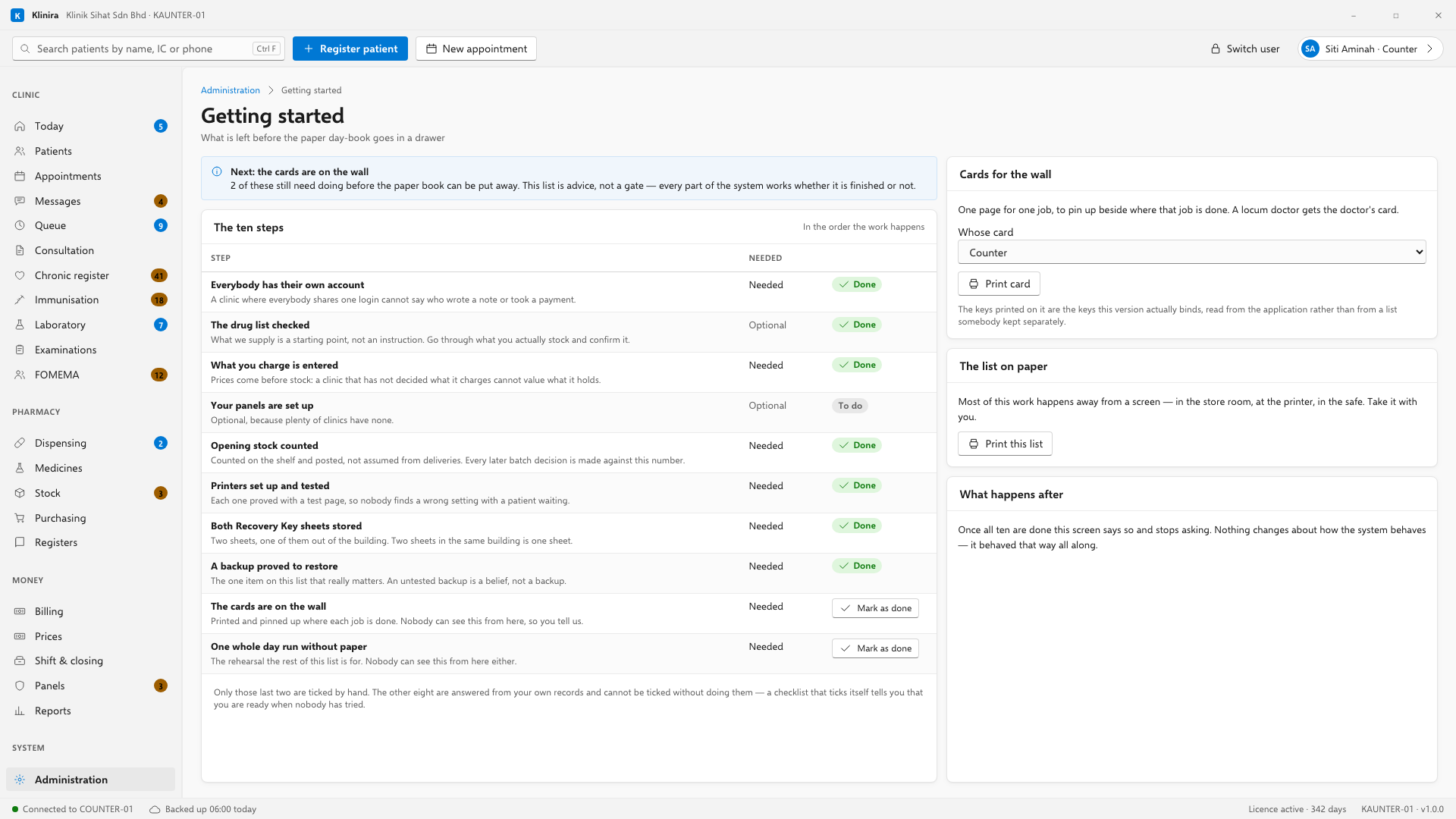
The ten, in the order the work happens
- 1Everybody who works here has their own account. A clinic where everybody shares one login cannot say who wrote a note or took a payment.
- 2Go through the drug list and confirm what you actually stock. What we supply is a starting point, not an instruction.
- 3Enter what you charge, on the Prices screen under Money. Prices come before stock: a clinic that has not decided what it charges cannot value what it holds.
- 4Set up your panels, if you have any. Plenty of clinics have none, so this one is optional.
- 5Count the opening stock on the shelf and post it. Not assumed from deliveries — every later batch decision is made against this number.
- 6Set up every printer and prove each one with a test page, so nobody finds a wrong setting with a patient waiting.
- 7Store both Recovery Key sheets, one of them out of the building. Two sheets in the same building is one sheet.
- 8Prove a backup actually restores. This is the one item on the list that really matters.
- 9Print the quick-reference cards and pin them up where each job is done.
- 10Run one whole day on the system with the paper book left in the drawer. This is the rehearsal the other nine are for.
Why two of them have a button and eight do not
Eight are answered from your own records: the system can see that seven accounts exist, that a stock take was posted, that a backup was restored and checked. It never asks you about those, and you cannot tick them without doing them.
Two are facts about a room. Whether the cards really got pinned up beside the counter, and whether a whole day was really run without paper, cannot be seen from a database — so you are asked, and you answer. A checklist that ticked itself would tell you that you are ready when nobody has tried.
Your prices
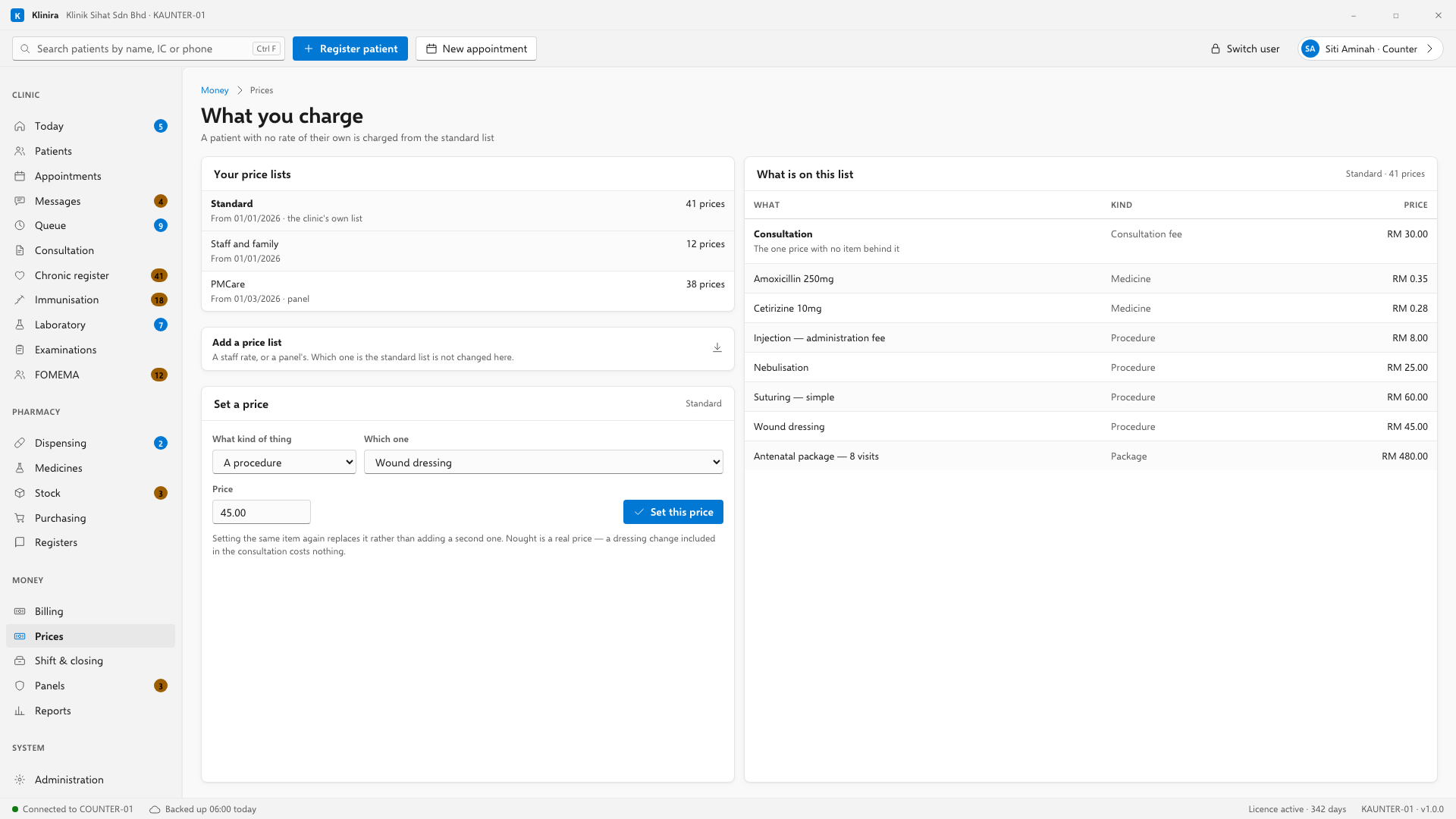
Set the consultation fee first, then the procedures you do most, then your medicines. You do not have to price everything before you open — anything without a price is typed in by hand on the bill — but every price you set is one the counter never has to remember.
- The consultation fee is the one price with nothing behind it. Everything else — a medicine, a procedure, a package — is priced against the thing itself.
- Nought is a real price. A dressing change you include in the consultation costs nothing, and that is what you should enter.
- Setting the same item again replaces the price. There is never a second price for one item on one list.
- A staff rate is a list of its own. Make it here, price it here, and put people on it from their own patient record.
Bringing your old records in
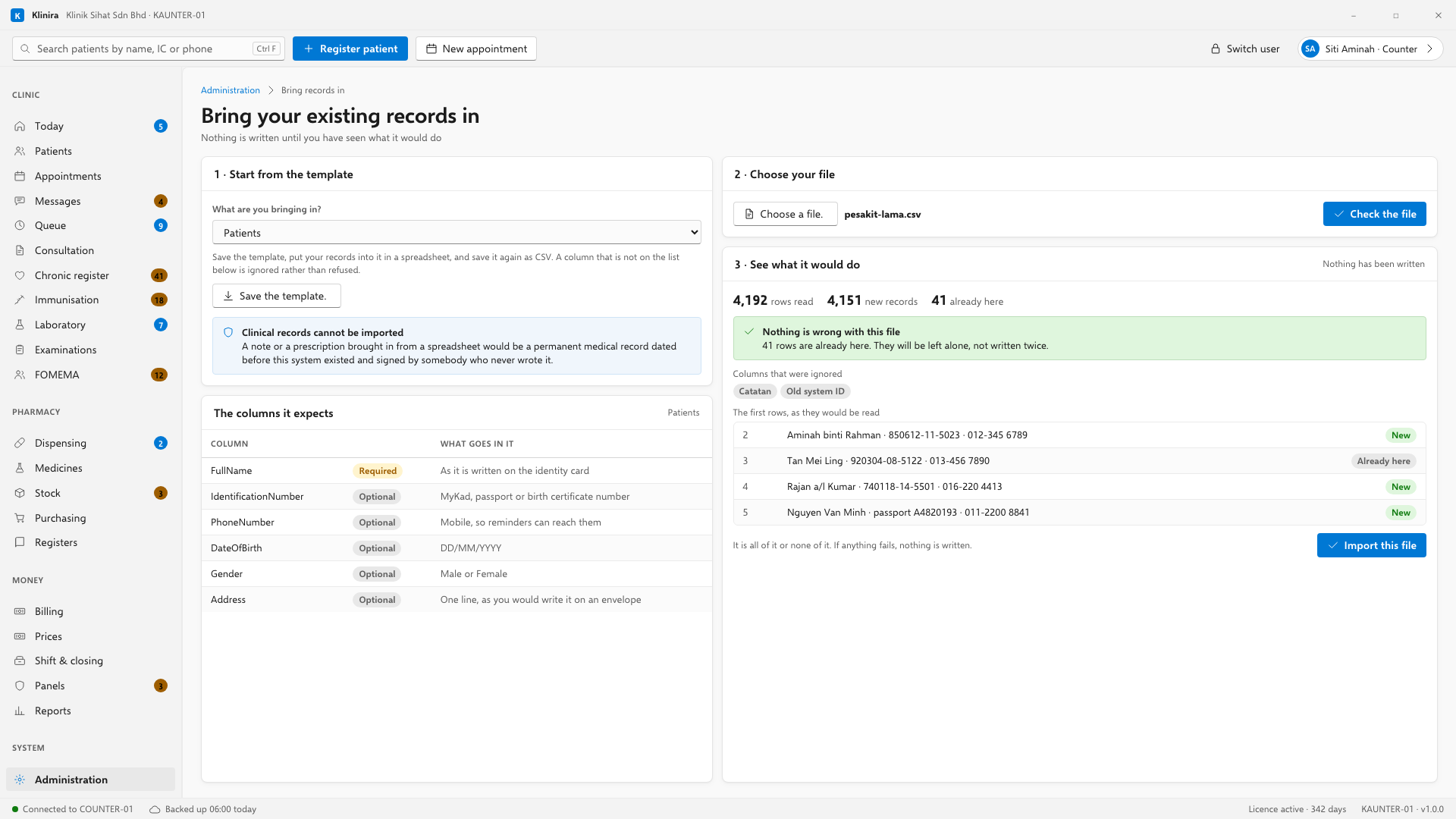
A patient list, your medicine list, what is on the shelf, and your prices can all come in from a spreadsheet. Save the template, put your records into it, save it again as CSV, and choose it here. You do not have to do this at all — a clinic can start with an empty patient list and add people as they walk in — but if you already have four thousand names typed somewhere, this is an afternoon rather than a fortnight.
- Check the file before you import it. The third card shows the first rows exactly as Klinira read them, so you can see that column three really is the telephone number before anything is written.
- It is all of it or none of it. If one row is wrong, nothing goes in — so you fix that row and run the same file again.
- Rows that are already here are left alone, not written twice. Running a corrected file again is safe and is what we expect you to do.
- A column we do not recognise is ignored rather than refused, and the third card names every one it ignored. If a heading you expected is on that list, it was spelled differently.
Cards for the wall
One page for one job — counter, doctor, nurse, pharmacy, accounts, owner — with the keys and the steps that job uses. Print them from this screen and pin them where the work happens. A locum doctor gets the doctor's card and needs no other introduction.
Take a place in the first installs
Klinira is being built now. Leave your details and you will hear what is finished, be asked what your clinic actually needs, and get the first install dates when it is ready.