JPJ, food handler and other examinations
The four examinations a clinic does for somebody who is not the patient — a licensing authority, an employer, an insurer. Filled in on screen, numbered, registered, and printed on the clinic's letterhead.
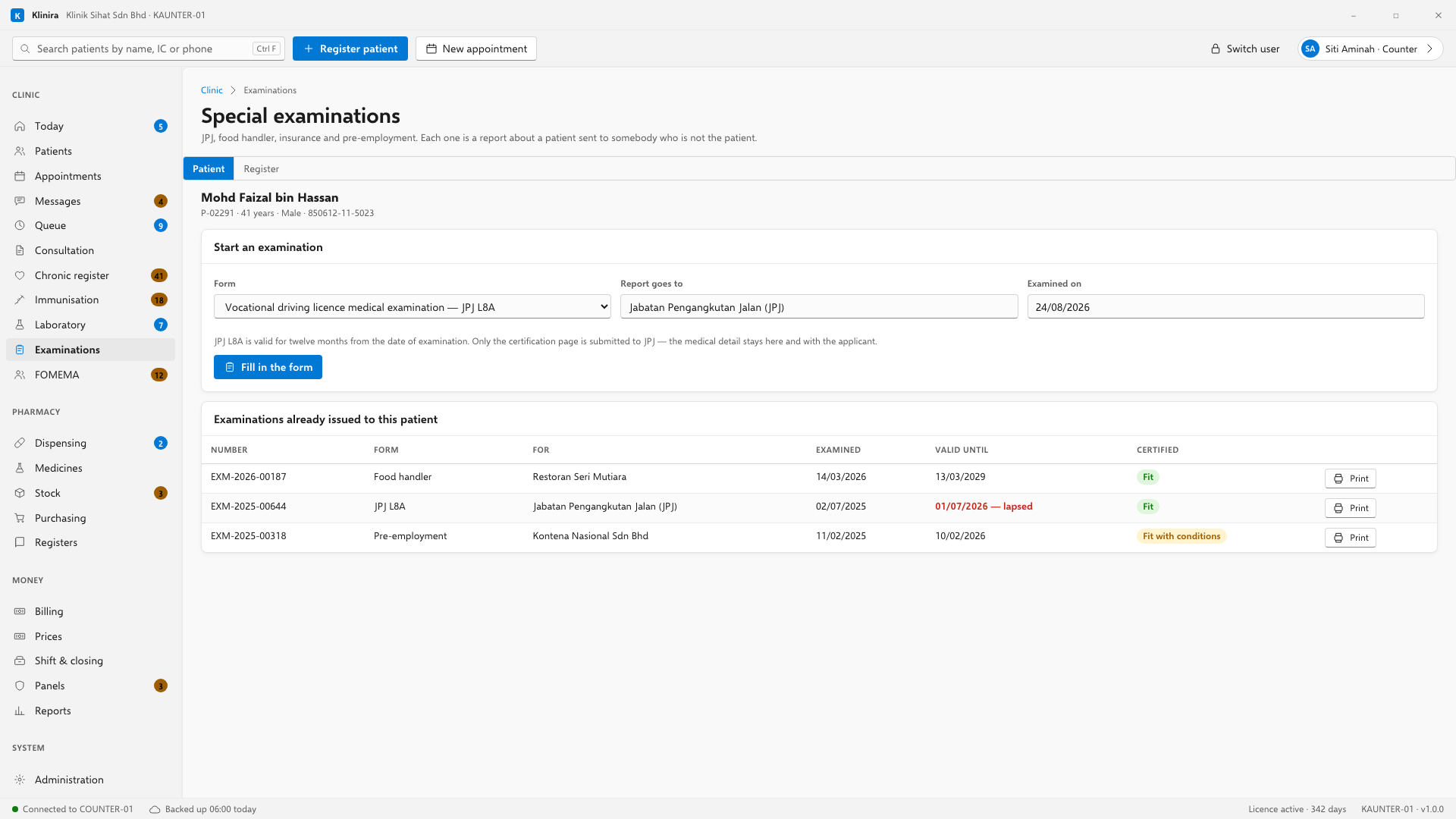
These are weekly cash work for most general practices: a lorry driver renewing a vocational licence, a kitchen hand who needs a food handler's certificate before the restaurant will put him on the roster, an insurance applicant, somebody starting a job on Monday.
The four forms
| Form | Goes to | Good for |
|---|---|---|
| JPJ L8A — vocational licence | Jabatan Pengangkutan Jalan | 12 months |
| Food handler | The food premises owner | 36 months |
| Insurance medical report | The insurer named on it | No expiry |
| Pre-employment | The employer named on it | 12 months |
Doing one
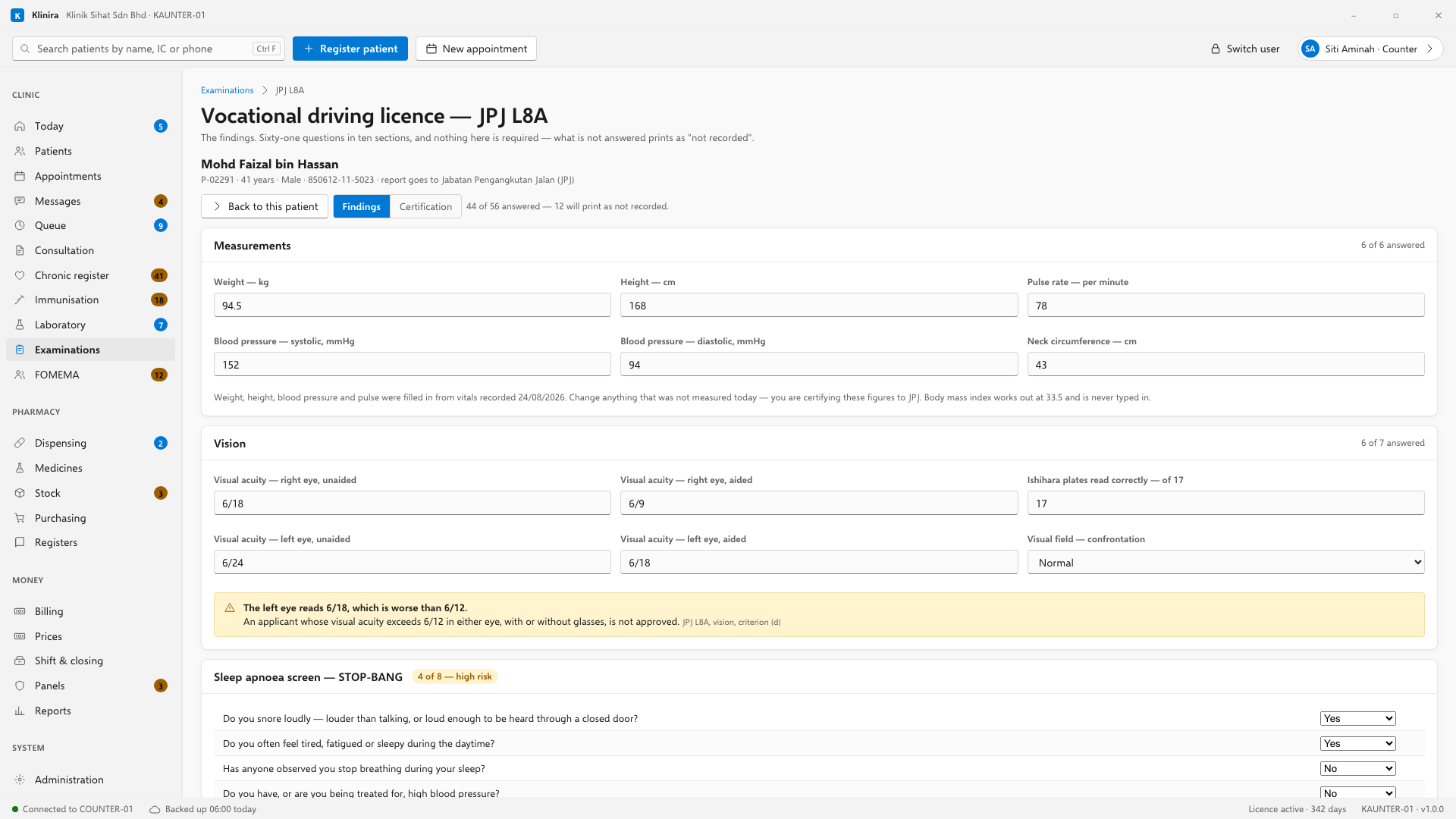
The form has two halves and a strip to move between them: the findings, which is the examination, and the certification, which is the signature. That is the same split as JPJ's own form, which puts the examination on one page and the certification on another — and the same split as who does the work, since a nurse can fill in the findings and only a doctor can certify.
- 1Open the patient, go to Examinations, choose the form and type who the report is for.
- 2Press Fill in the form. What the clinic already knows is filled in — change anything that was not measured today.
- 3Work down the sections. Nothing on the form is compulsory. Where a reading is one the receiving body would refuse on, their own sentence appears beside it.
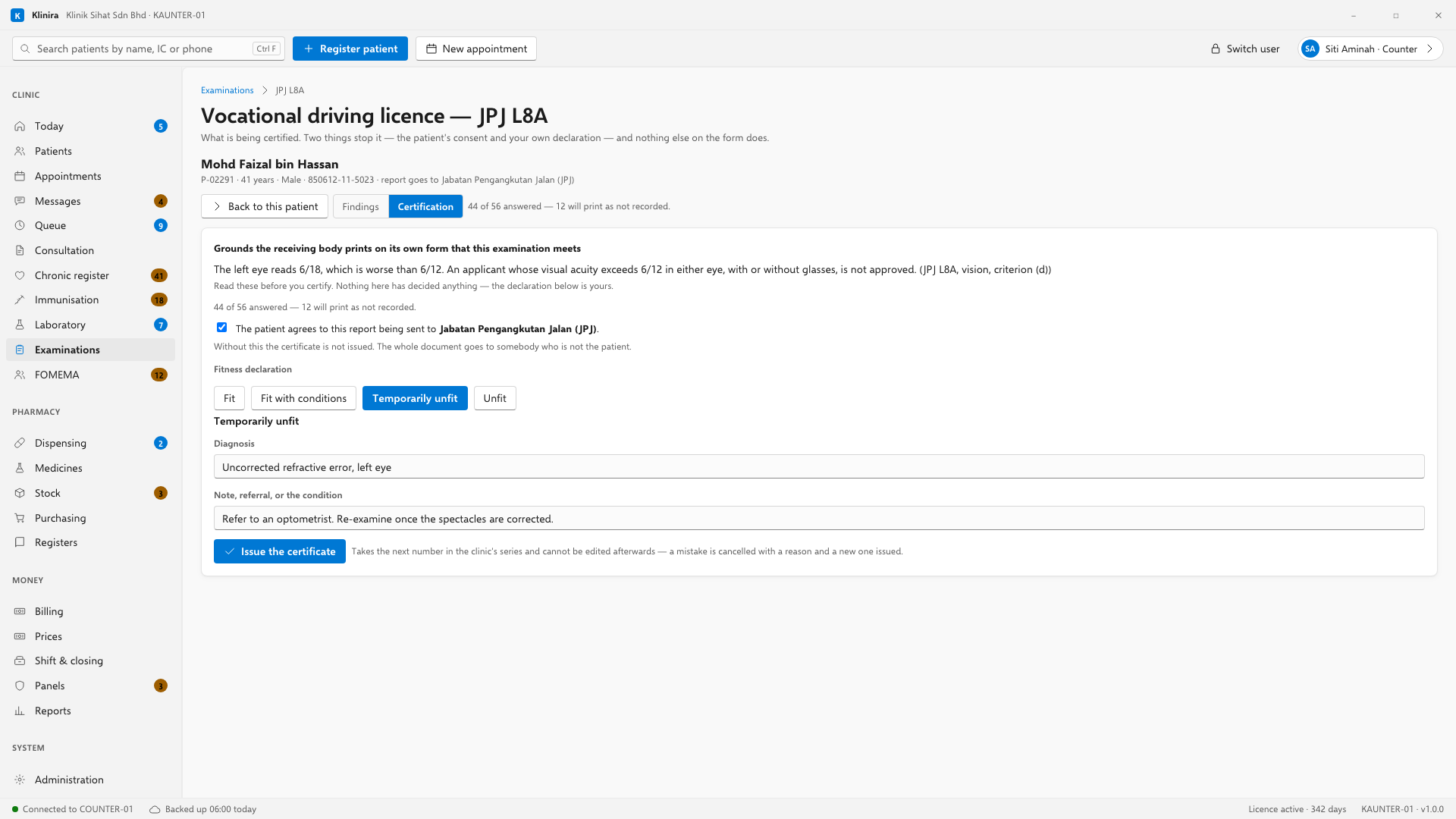
- 4Go to the certification.
- 5Tick that the patient agrees to the report being sent, and choose what you are certifying.
- 6Issue it. It takes the next number and prints.
Two things stop it, and only two
- The patient has to agree to the report being sent, and the report has to say who it is for. The whole document goes to somebody who is not the patient — an employer deciding whether to hire them, an insurer deciding whether to cover them.
- You have to say what you are certifying. A certificate with no fitness statement on it is not a certificate.
Everything else is a note and not a block. A question you did not answer prints as “not recorded”, and the line above the Issue button says how many that is — so a reader of the certificate knows what they are holding.
What the screen will not do
The typhoid injection
A food handler's certificate is worth nothing without the anti-typhoid vaccination behind it, and the vaccine is renewed every three years. Record the injection in the immunisation record as usual — the certificate reads the date back from there, and its expiry runs from the day of the injection, not from the day of the examination.
The urine drug test
Pre-employment is not the DOSH examination
If a worker is exposed to a chemical hazardous to health, the law requires medical surveillance and only a doctor registered with DOSH as an Occupational Health Doctor may do it, on DOSH's own forms. An ordinary pre-employment examination is a different thing, and this screen says so when you open that form.
The register, and what is about to lapse
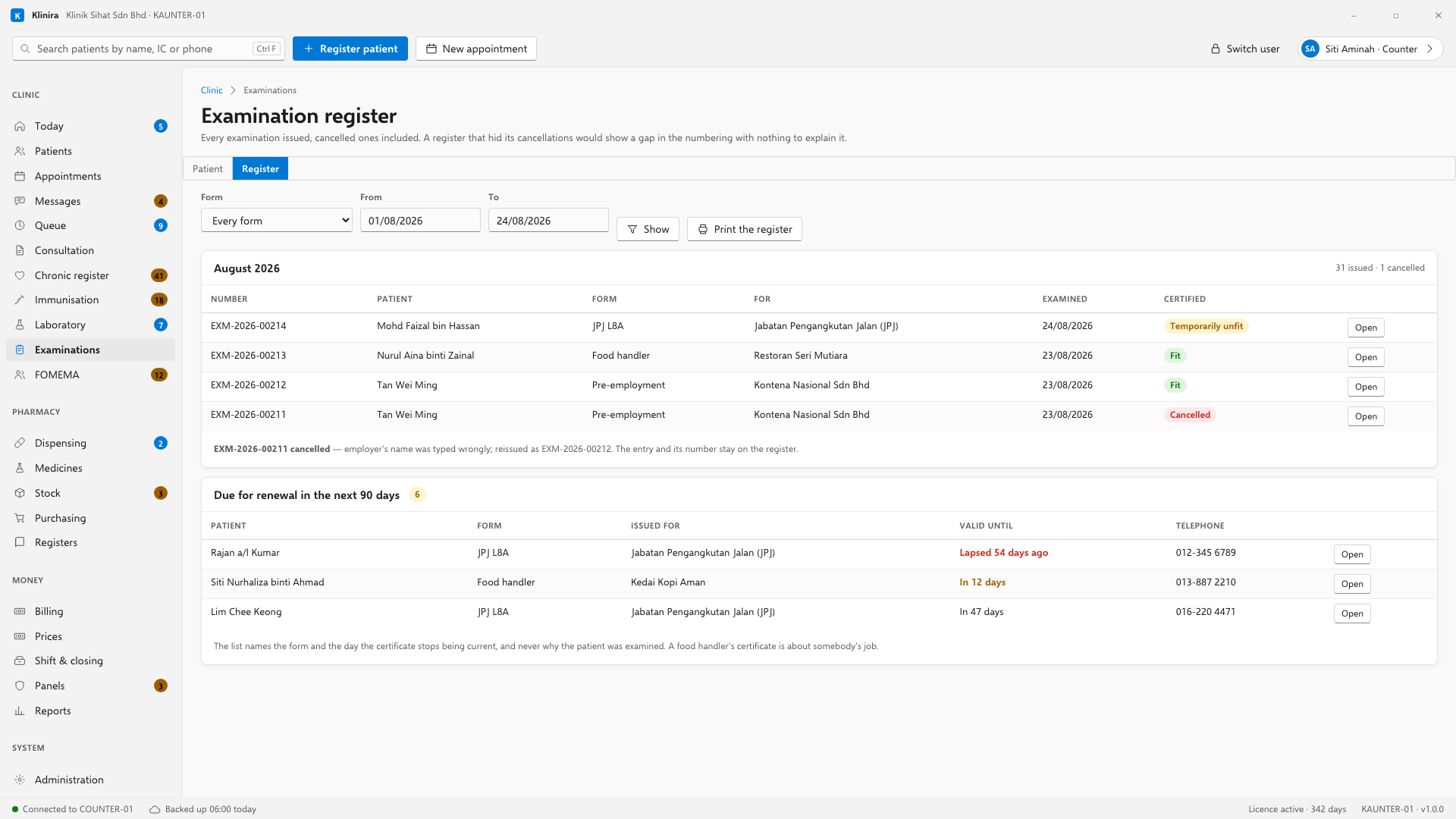
- An issued examination is never edited. The patient is holding the paper and the employer may already have a copy, so an edit would leave two different documents carrying one number. Cancel it with a reason and issue a new one.
- The cancelled entry stays on the register with its number. A gap in a numbered series is the first thing anybody asks about.
- The renewal list is repeat business. It names the form and the date and never why the patient was examined — a food handler's certificate is about somebody's job.
Who may do what
A nurse can open the screen, fill the whole form in and read the register: the height, the weight, the blood pressure, the eye chart, the whisper test and the urine dipstick are the nurse's work. Only a doctor can make the fitness declaration and issue it.
The printed copy
For the JPJ examination the printed copy is the clinic's own record, not a copy of the government form — only the certification page of the JPJ form goes to JPJ, and the figures print in the order that form asks for them so copying them across is straightforward. For the other three, the printed copy is the certificate.
Take a place in the first installs
Klinira is being built now. Leave your details and you will hear what is finished, be asked what your clinic actually needs, and get the first install dates when it is ready.